African chess made its presence felt at the Samarkand Chess Olympiad, the 46th edition of FIDE’s flagship team event, with four category medals, strong individual federation performances, and a new generation of players offering a glimpse into the continent’s future.
The 46th FIDE Chess Olympiad, held in Samarkand, Uzbekistan, from 16 to 27 September 2026, provided another important opportunity to assess the progress, competitiveness and growing international presence of African chess.
Across the Open and Women’s sections, African federations competed against some of the world’s strongest chess nations in the eleven-round team competition. While the overall Olympiad titles went to Uzbekistan in the Open Section and China in the Women’s Section, Africa had its own reasons to celebrate.
Ghana’s Women’s team secured gold in Rating Category D, Ethiopia claimed bronze in the same category, Tanzania won silver in Women’s Category E, and Kenya’s Open team earned bronze in Open Category D.
Beyond the medals, the final standings also revealed encouraging performances from several African federations. Angola emerged as Africa’s strongest combined performer, Algeria led the continent in the Open Section, while Egypt recorded the best African finish in the Women’s Section.
The competition also offered an interesting look at the age profile of African teams, highlighting both the continent’s young talent and the experience represented by some of its national squads.
Africa’s Top Performing Federations: The Combined Picture
Looking at the Open and Women’s final standings together provides a broader picture of each federation’s performance in Samarkand.
Using the sum of each federation’s final global position in both sections, Angola emerged as Africa’s leading federation with a combined score of 150, narrowly ahead of Algeria on 152 and Egypt on 155.
This combined view recognises federations that were able to produce competitive results across both sections rather than relying on the performance of only one team.
Top 10 African Federations – Combined Open and Women’s Results
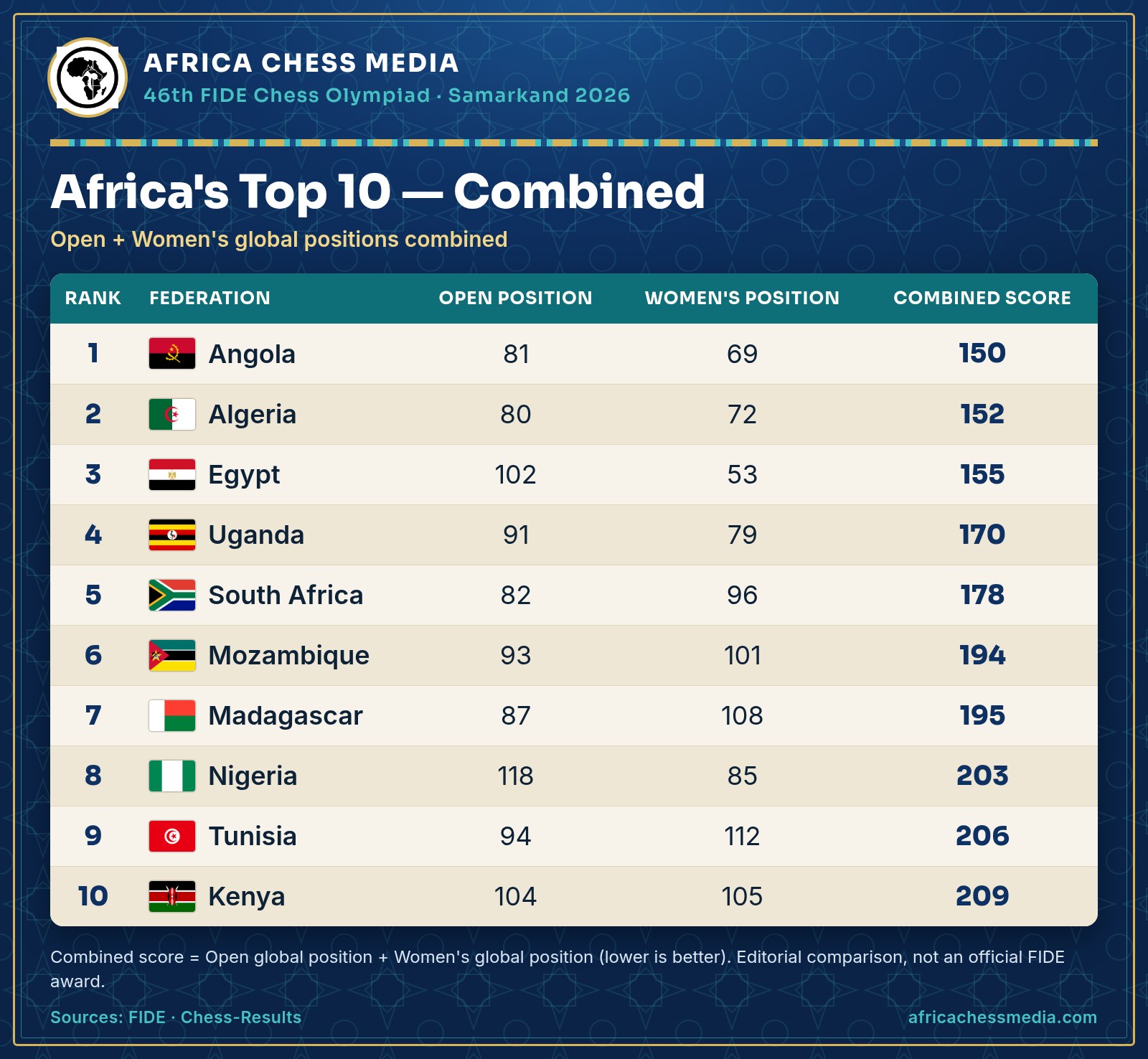
The combined score is the sum of the federation’s Open and Women’s global finishing positions. A lower score represents a stronger combined placing. This is an editorial comparison, not an official FIDE Olympiad award.
Angola’s first-place position reflects the consistency of its two teams, both of which finished inside the top 100 globally. Algeria followed closely, with its Open team producing Africa’s best finish in that section. Egypt’s third-place combined position was driven particularly by its impressive Women’s team performance.
Uganda and South Africa also demonstrated the value of having competitive teams in both sections, while Mozambique and Madagascar completed the top seven.
Nigeria’s eighth-place combined position was supported by a stronger Women’s finish, while Tunisia and Kenya completed the continental top ten.
Open Section: Algeria Leads Africa
Algeria finished as Africa’s highest-ranked federation in the Open Section, taking 80th place globally. Angola followed closely in 81st, with South Africa just behind in 82nd.
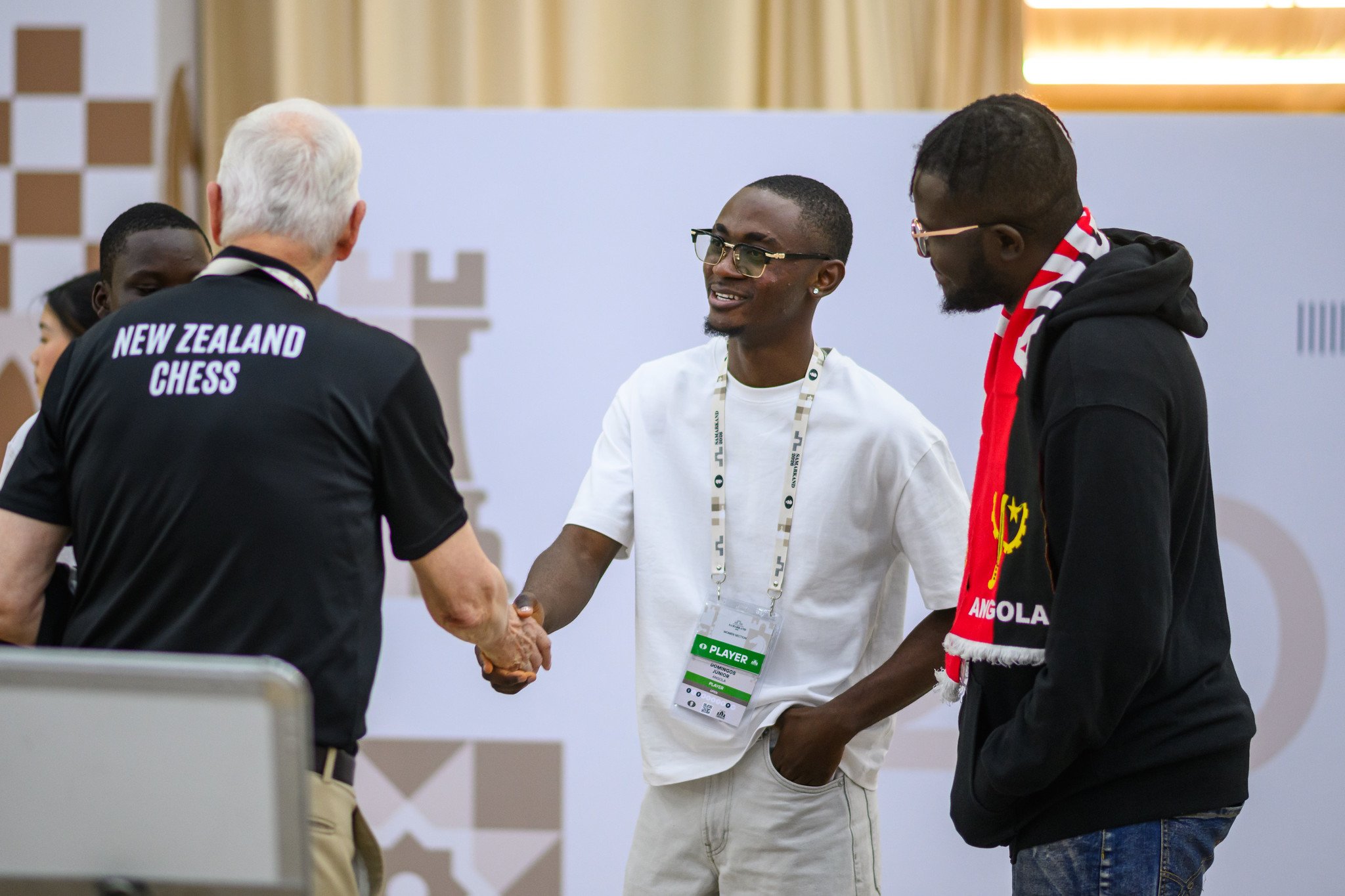
The narrow margins between these three federations underline the competitive balance among some of Africa’s leading Open teams.
Madagascar placed 87th, Libya finished 90th, and Uganda took 91st. Mozambique, Tunisia, Zambia and Egypt completed the African top ten.
Top 10 African Federations – Open Section
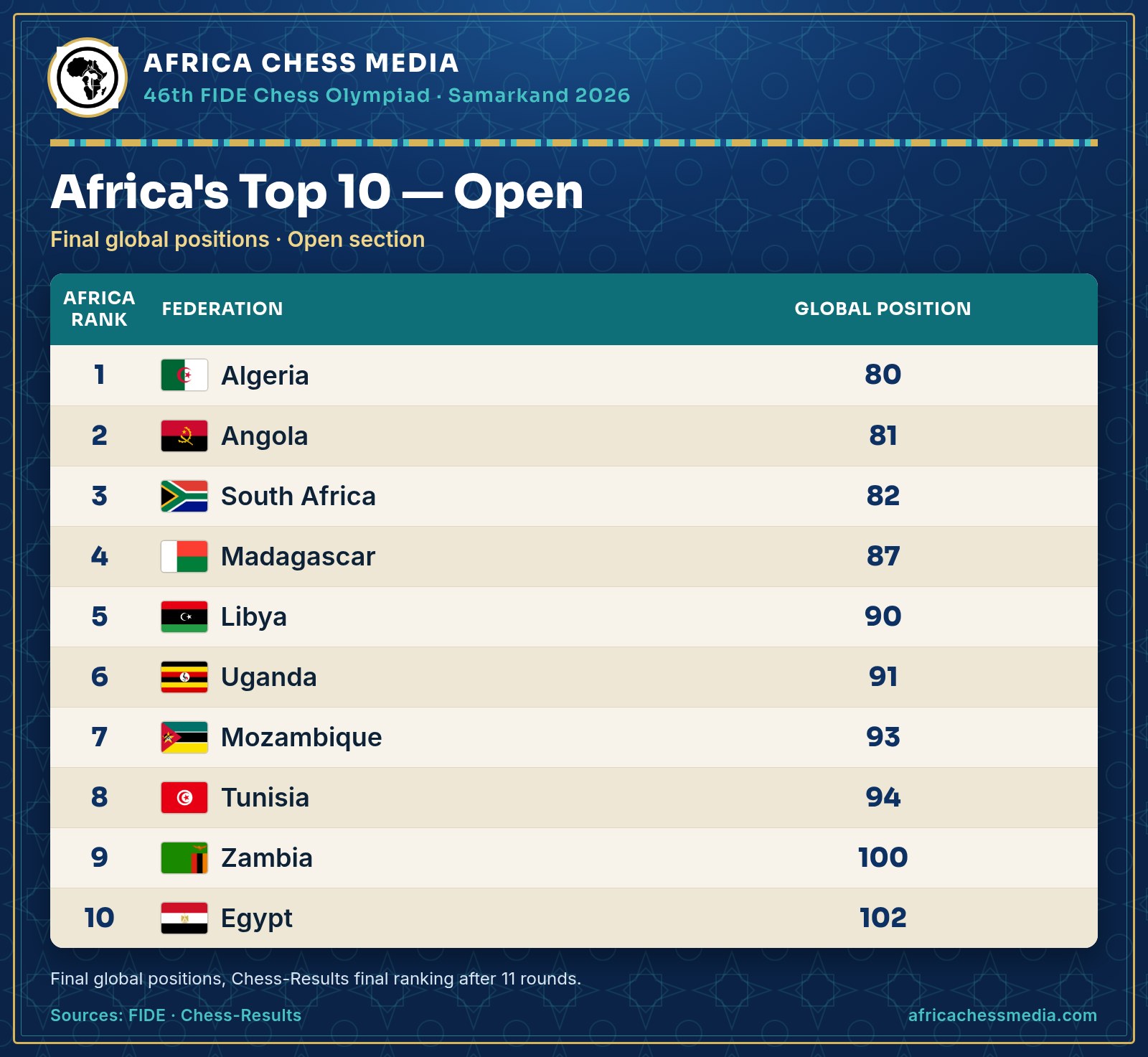
Algeria’s position at the top of the African list is an encouraging indicator of its continued competitiveness. Angola and South Africa’s close finishes also show that the leading positions on the continent are increasingly contested.
Madagascar, Libya and Uganda’s appearances in the top six further demonstrate the geographical spread of competitive Open chess across Africa.
Women’s Section: Egypt Sets the Pace
Egypt produced Africa’s best team finish in the Women’s Section, ending the competition in 53rd place globally.
Angola finished 69th, while Algeria placed 72nd. Uganda followed in 79th, with Ghana taking 81st place.
Nigeria’s Women’s team finished 85th, ahead of Morocco, South Africa, Ethiopia and Mozambique, who completed the African top ten.
Top 10 African Federations – Women’s Section
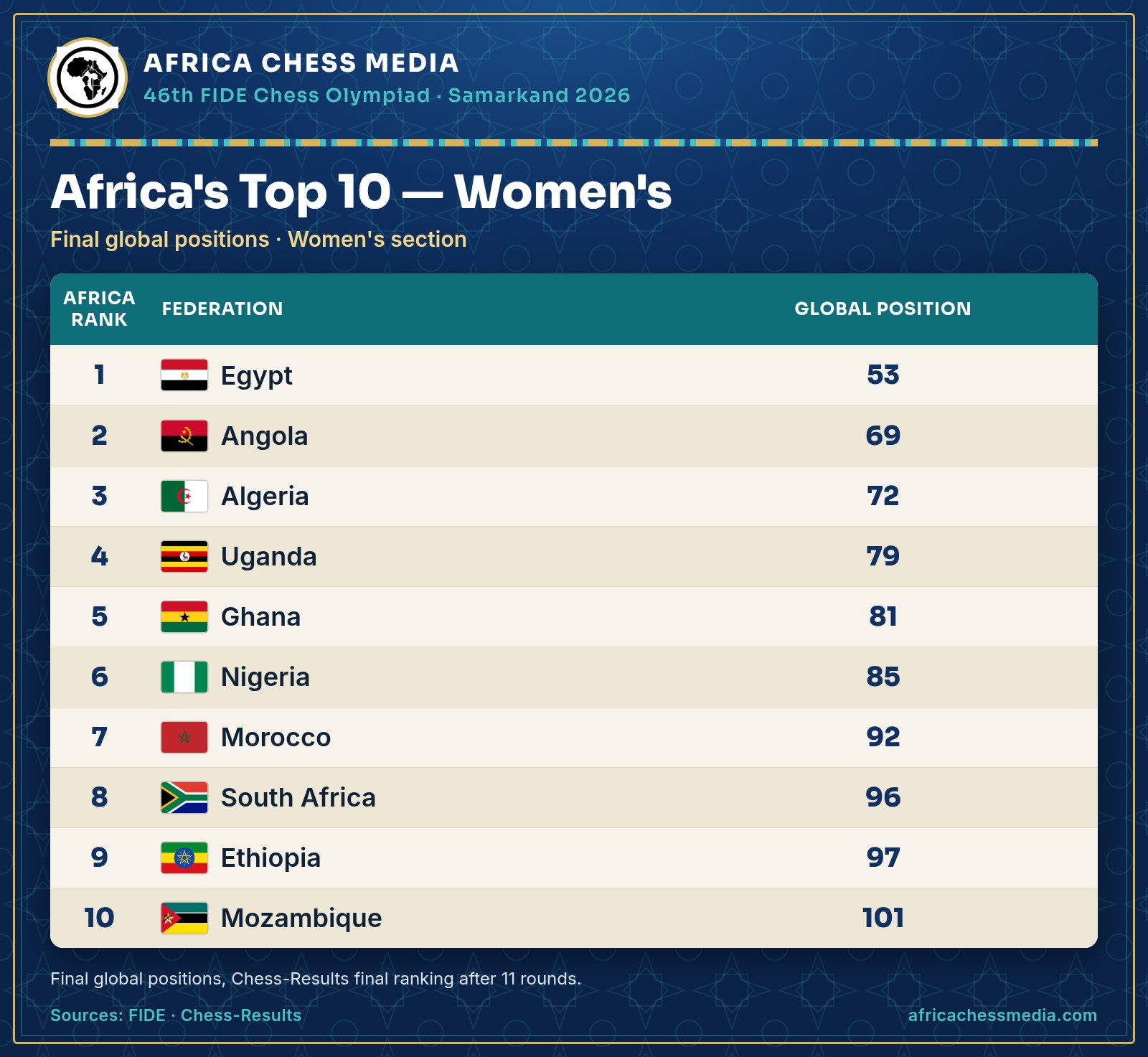
Egypt’s 53rd-place finish gave the federation its strongest African placing across the two sections. Angola and Algeria also produced solid results, while Uganda’s fourth-place continental position reflected another competitive showing.
Ghana’s fifth-place finish was particularly notable in the context of its Category D gold medal, while Nigeria’s sixth-place position placed it firmly among the continent’s leading Women’s teams.
Four African Category Medals in Samarkand
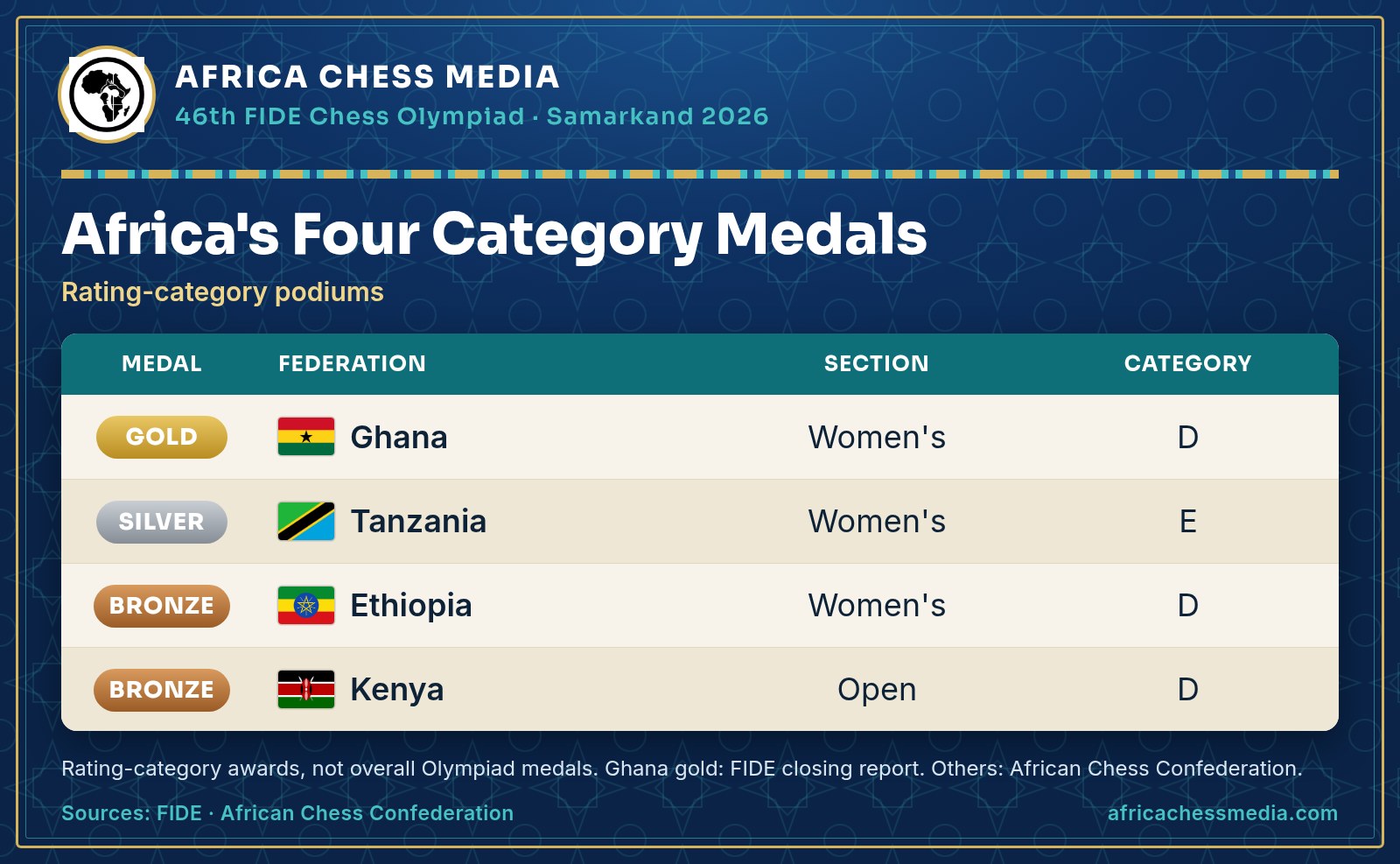
One of the most encouraging highlights of the Olympiad for Africa was the achievement of four national teams in the rating-category competitions.
The Olympiad’s category awards recognise the strongest teams within designated rating groups. These are separate from the overall Open and Women’s team medals awarded to the three highest-placed teams in each main section.
Africa secured one gold, one silver and two bronze medals across the two sections. FIDE’s closing report names Ghana among the category gold medallists; the silver and bronze medals below are as reported by the African Chess Confederation.
Women’s Section
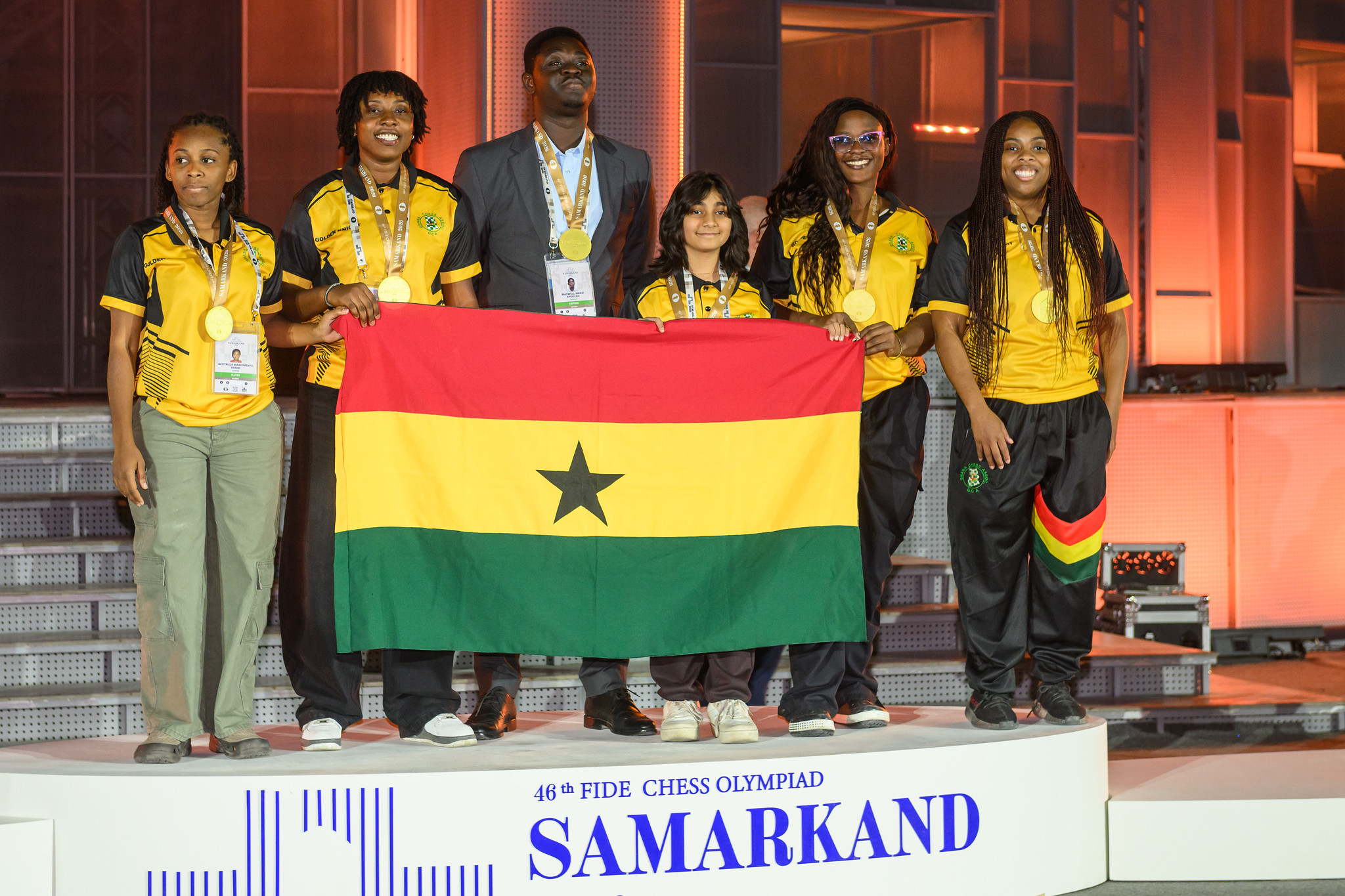
Ghana – Gold, Category D
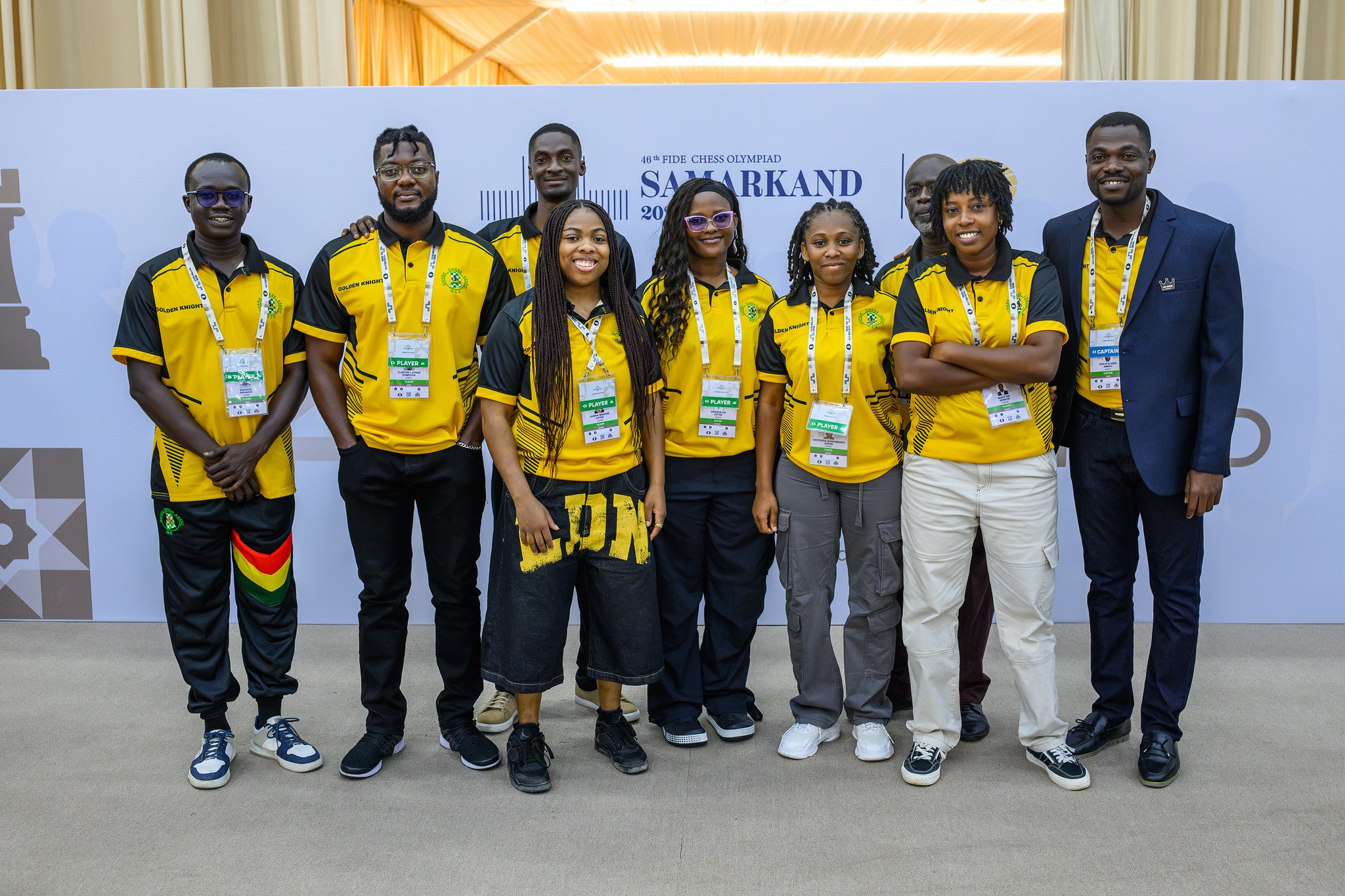
Ghana’s Women’s national team delivered one of the continent’s standout performances by winning Rating Category D. The achievement represented a significant milestone for Ghanaian chess and placed the team among the category champions recognised at the closing ceremony.
The Ghanaian team comprised Maud Benson, Gertrude Banini, Ridham, Dzidzor Esi Dotse and Sumya Ibrahim Dotse.
Ethiopia – Bronze, Category D
Ethiopia also reached the podium in Women’s Category D, securing the bronze medal and adding another African team to the category prize list.

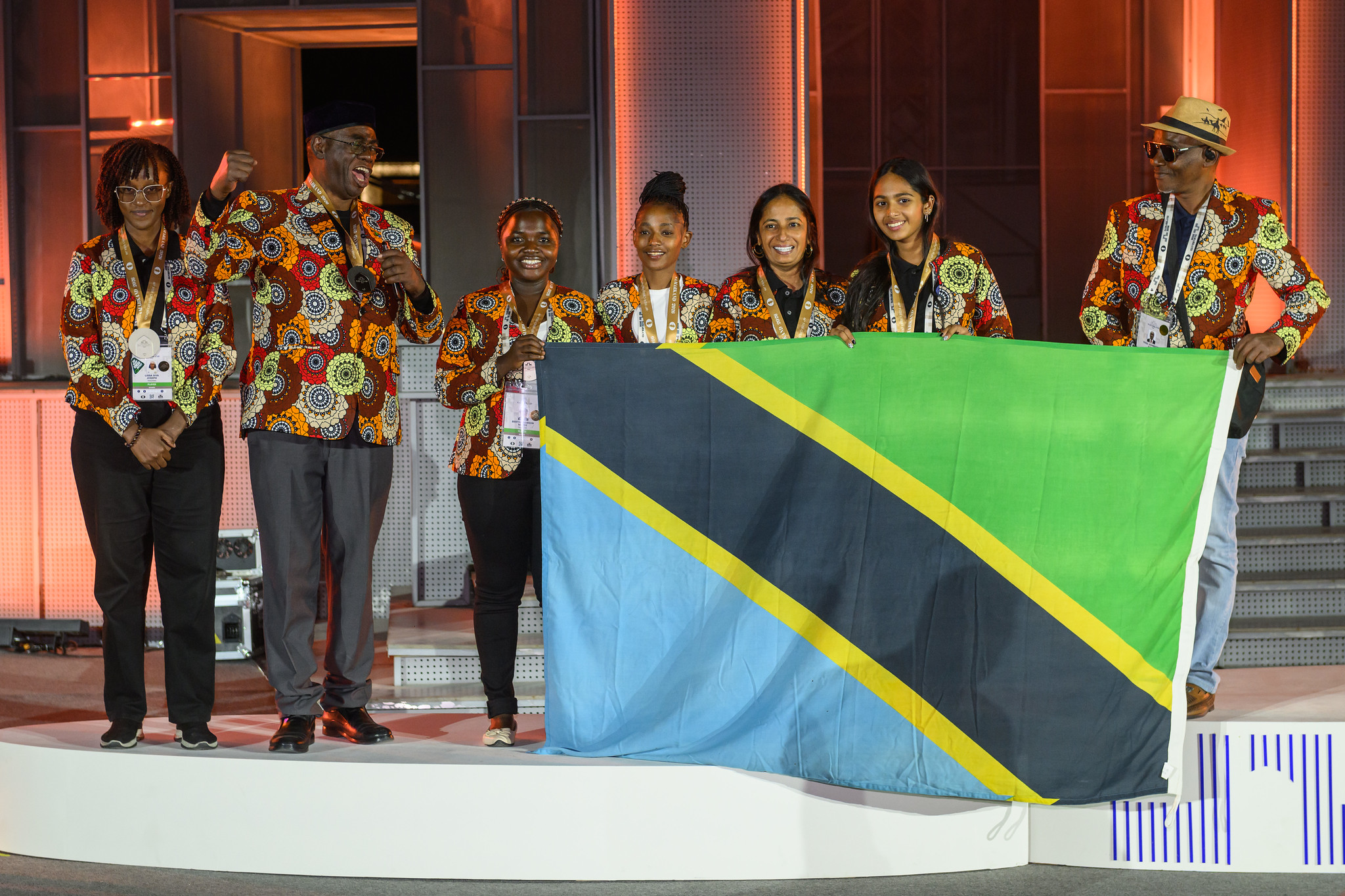
Tanzania – Silver, Category E
Tanzania’s Women’s team secured silver in Category E, completing a strong showing for East African chess and giving the region another reason to celebrate.
Open Section
Kenya – Bronze, Category D
Kenya’s Open team earned bronze in Category D after an encouraging campaign, further underlining the growing competitiveness of East African federations in international team chess.
The four awards gave Africa a total of four category medals: Ghana’s gold, Tanzania’s silver, and bronze medals for Ethiopia and Kenya.
These achievements deserve recognition, but they should also be understood in their proper context. They were rating-category awards and not medals in the overall Open or Women’s Olympiad standings.
African Recognition Beyond the Chessboard
The Olympiad’s closing ceremony also recognised teams for their uniforms, celebrating the national identity, creativity and presentation that delegations brought to Samarkand.

South Africa and Mali were among the teams recognised in the best-uniform awards across the different categories and sections.

This added another dimension to Africa’s presence at the event, demonstrating that national delegations contributed to the wider cultural experience of the Olympiad as well as the competition itself.
The Age Factor: How Young Were Africa’s Olympiad Teams?
Beyond the results, medals and individual performances, the 46th Chess Olympiad also offered an interesting perspective on the age profile of Africa’s national teams.
An analysis of all ninety-five (95) African teams (49 in the Open Section and 46 in the Women’s Section) reveals a continent combining youthful talent with valuable experience.
Using birth years recorded on FIDE player profiles, the approximate average age of each team was calculated by subtracting each player’s year of birth from 2026 and averaging the figures across the registered squad.
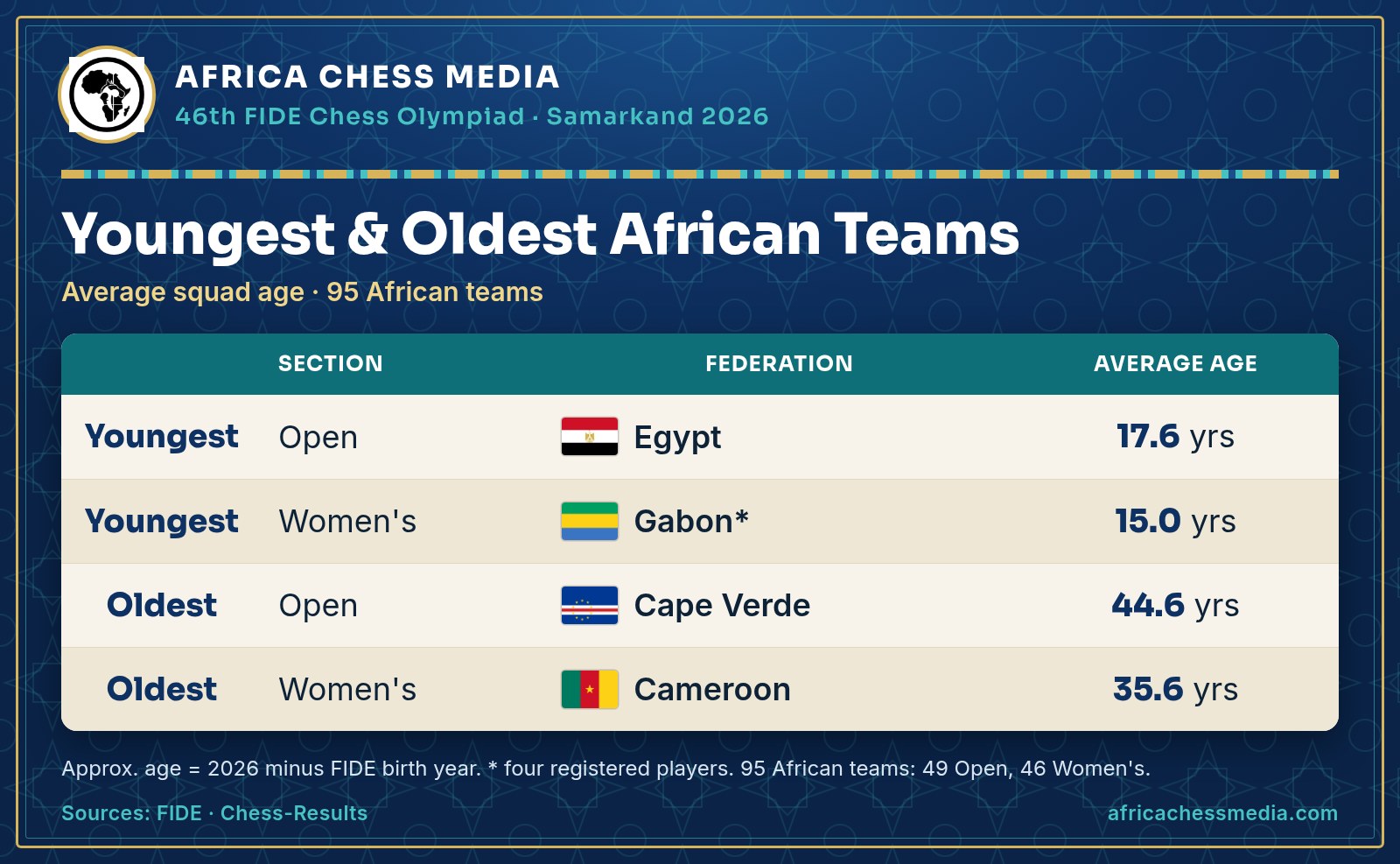
Youngest and Oldest African Teams
Open Section
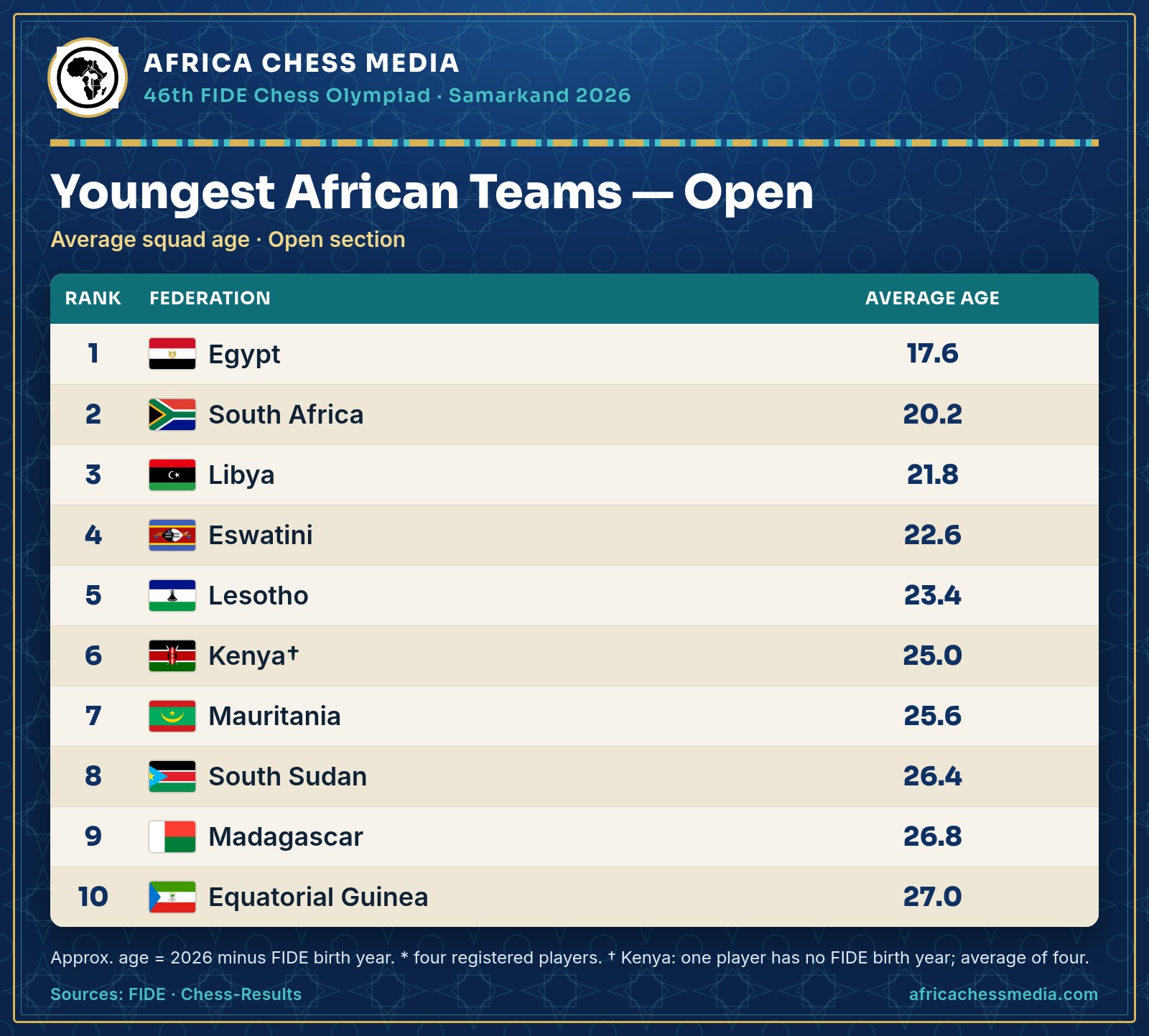
- Youngest: Egypt – 17.6 years
- Oldest: Cape Verde – 44.6 years
Women’s Section
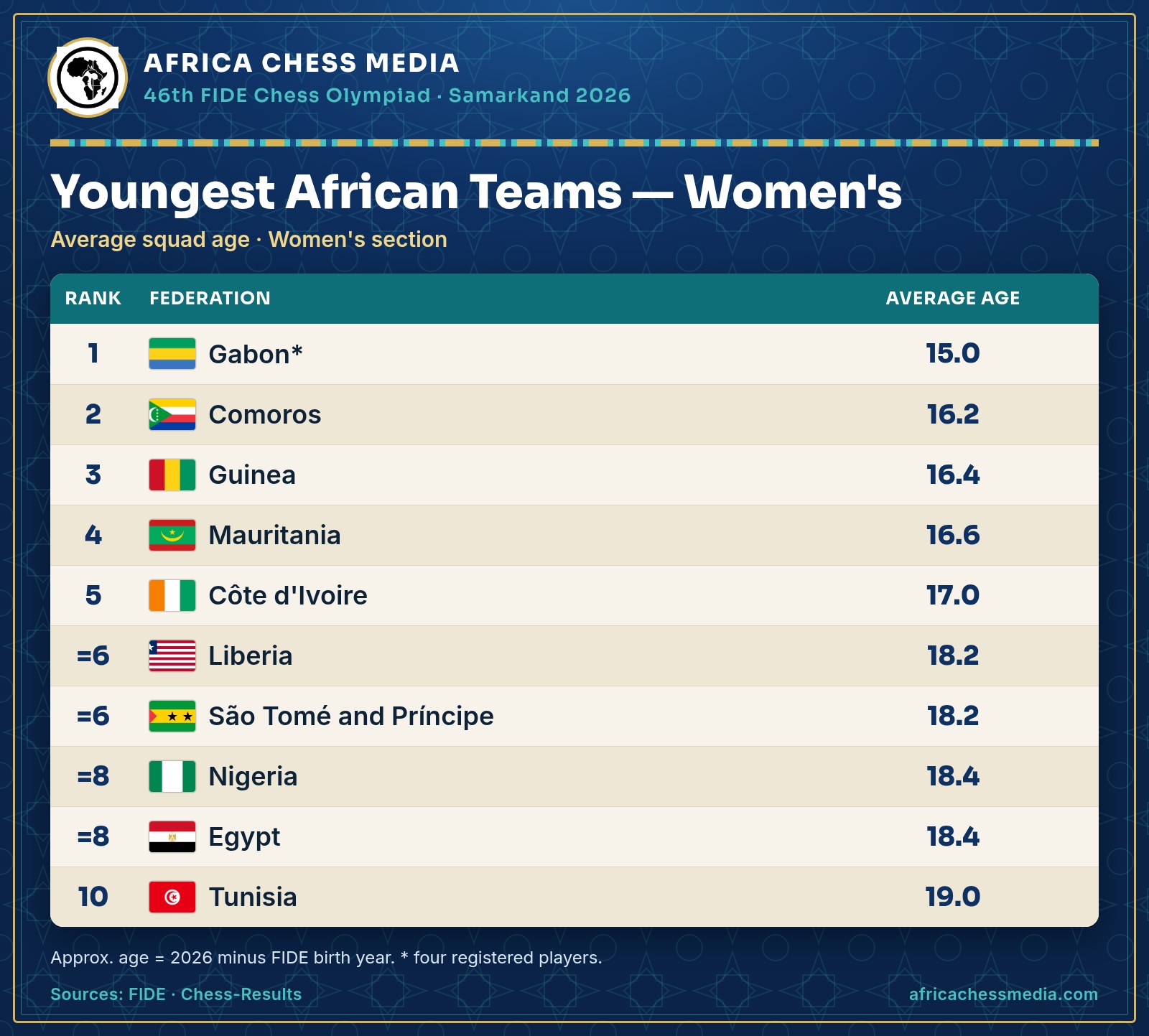
- Youngest: Gabon – 15.0 years*
- Oldest: Cameroon – 35.6 years
The figures highlight the youthful composition of some African teams, particularly in the Women’s Section, while also showing the experience represented by the continent’s older squads.
Top 10 Youngest African Teams – Open Section
Top 10 Youngest African Teams – Women’s Section
Egypt’s Open team emerged as Africa’s youngest, with an average age of just 17.6 years. South Africa followed at 20.2, while Libya, Eswatini and Lesotho also featured prominently.

In the Women’s Section, Gabon topped the list with an average age of 15.0 years, followed by Comoros, Guinea, Mauritania and Côte d’Ivoire. The presence of Liberia, São Tomé and Príncipe, Nigeria and Egypt among the ten youngest teams further illustrates the youth represented in African Women’s chess.
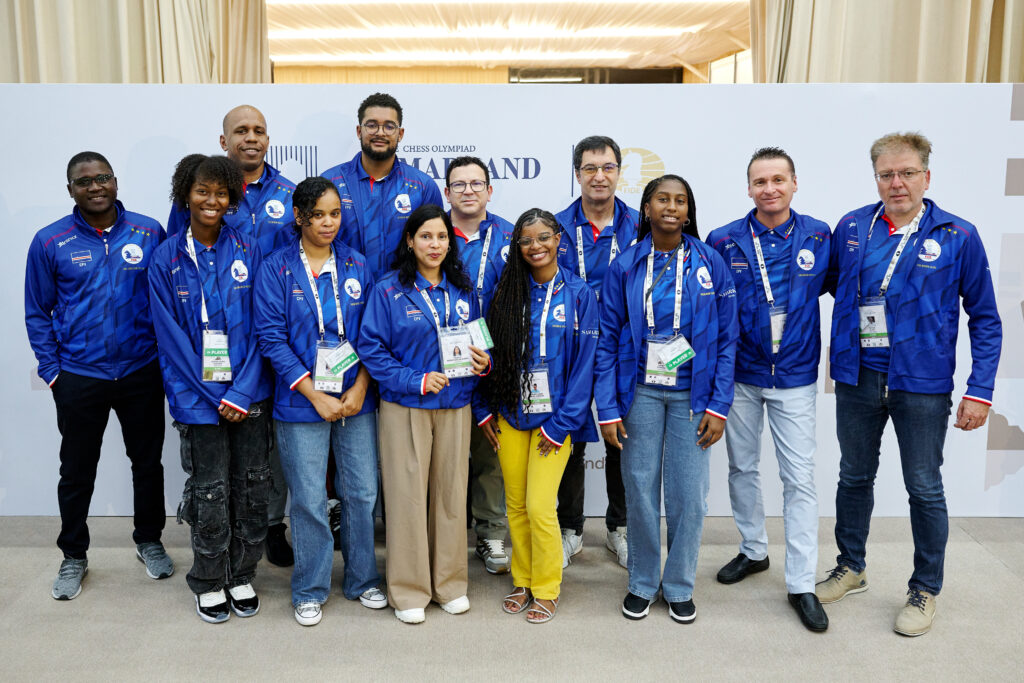
At the other end of the scale, Cape Verde’s Open team recorded the highest average age at 44.6 years, while Cameroon was the oldest team in the Women’s Section at 35.6 years.
Methodology and notes: Approximate age was calculated as 2026 minus each player’s recorded year of birth. Team averages were calculated using all registered players. Teams with four registered players are marked with an asterisk (*), with their averages calculated using those four players. Figures are approximate and do not represent players’ exact ages on the opening day of the Olympiad.
† Kenya’s Open team: Kenneth Omolo has no year of birth recorded on his FIDE profile. Consequently, the team’s average is based on the other four players.

The age analysis is particularly relevant to discussions about the future of African chess. A number of federations are already fielding teams with very young players, creating opportunities for long-term development, international exposure and stronger competitive experience.
However, youth alone does not guarantee future success. The challenge for federations is to build consistent structures around these players — including coaching, tournament access, financial support, preparation and regular international competition — so that emerging talent can develop into established performers.
Samarkand: A Fitting Stage for the Chess World
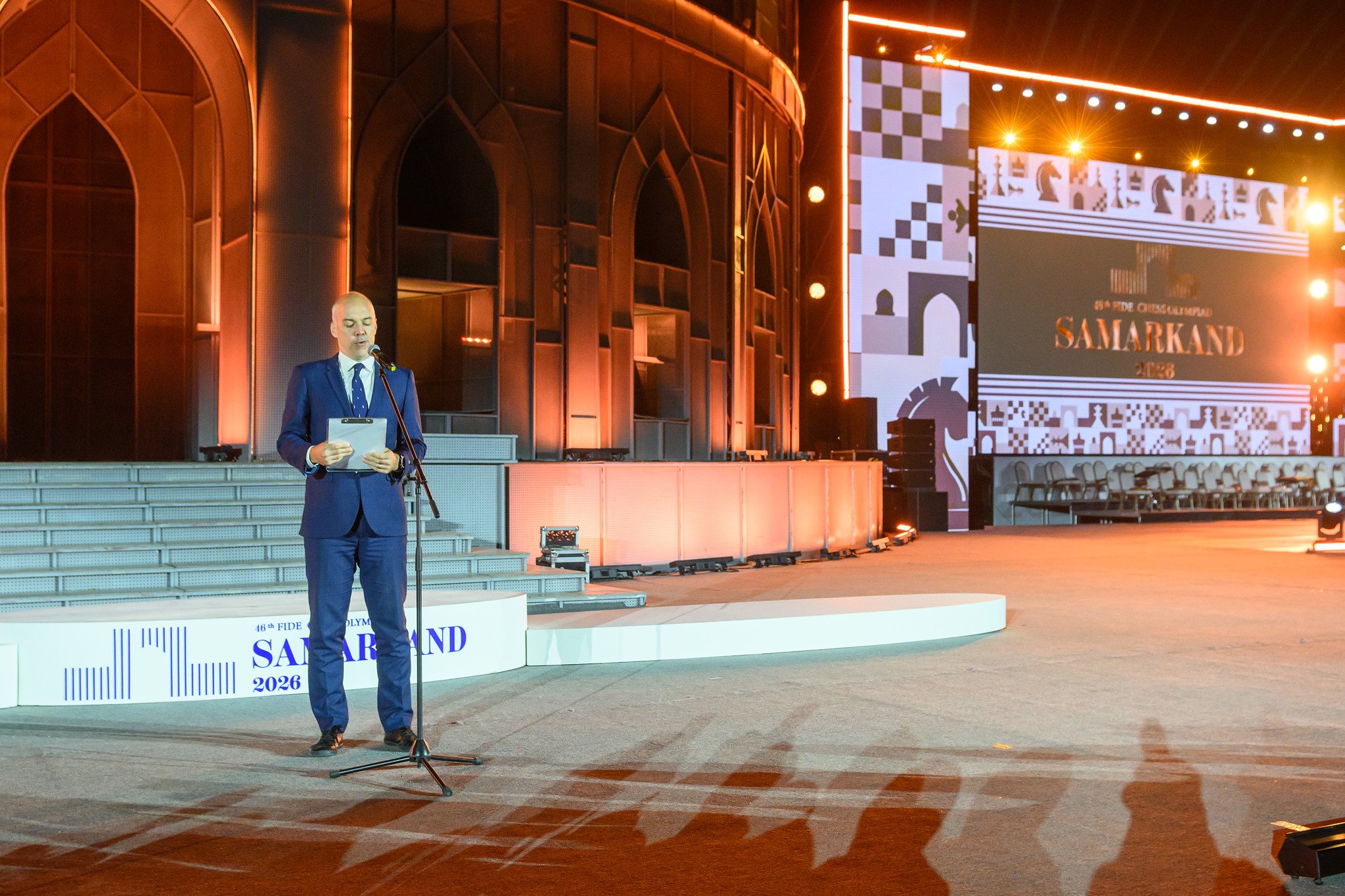
The 46th Olympiad was held in Samarkand, one of Uzbekistan’s most historically significant cities and a celebrated centre along the ancient Silk Road.
For the host nation, the tournament ended in spectacular fashion. Uzbekistan won the Open Section, securing its second Olympiad title after its triumph in Chennai in 2022. China claimed the Women’s title, with Kazakhstan taking silver and India bronze. In the Open Section, India finished second and Germany took third place.

India also won the Nona Gaprindashvili Trophy, awarded to the federation with the best combined result across the Open and Women’s competitions.
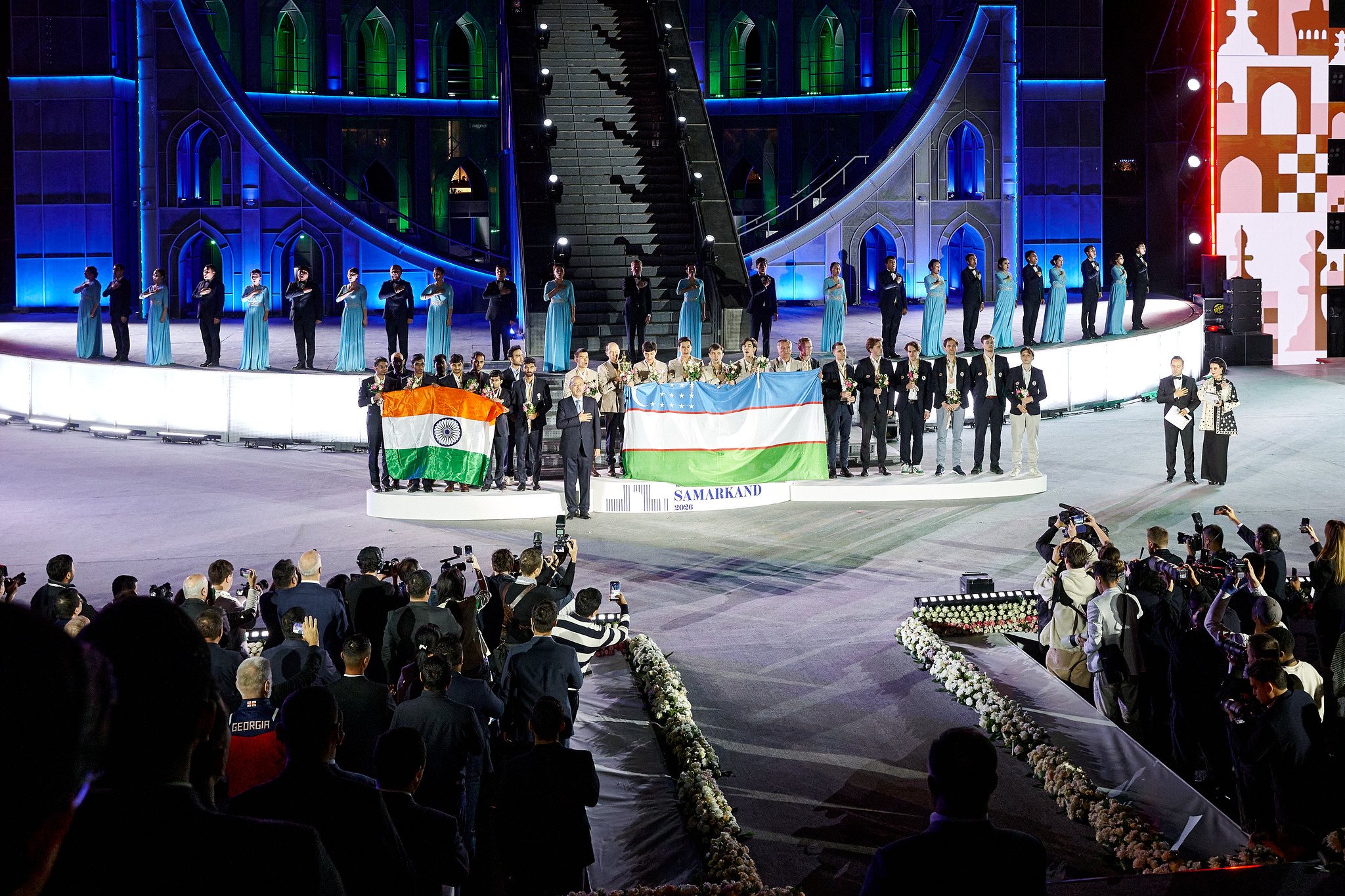
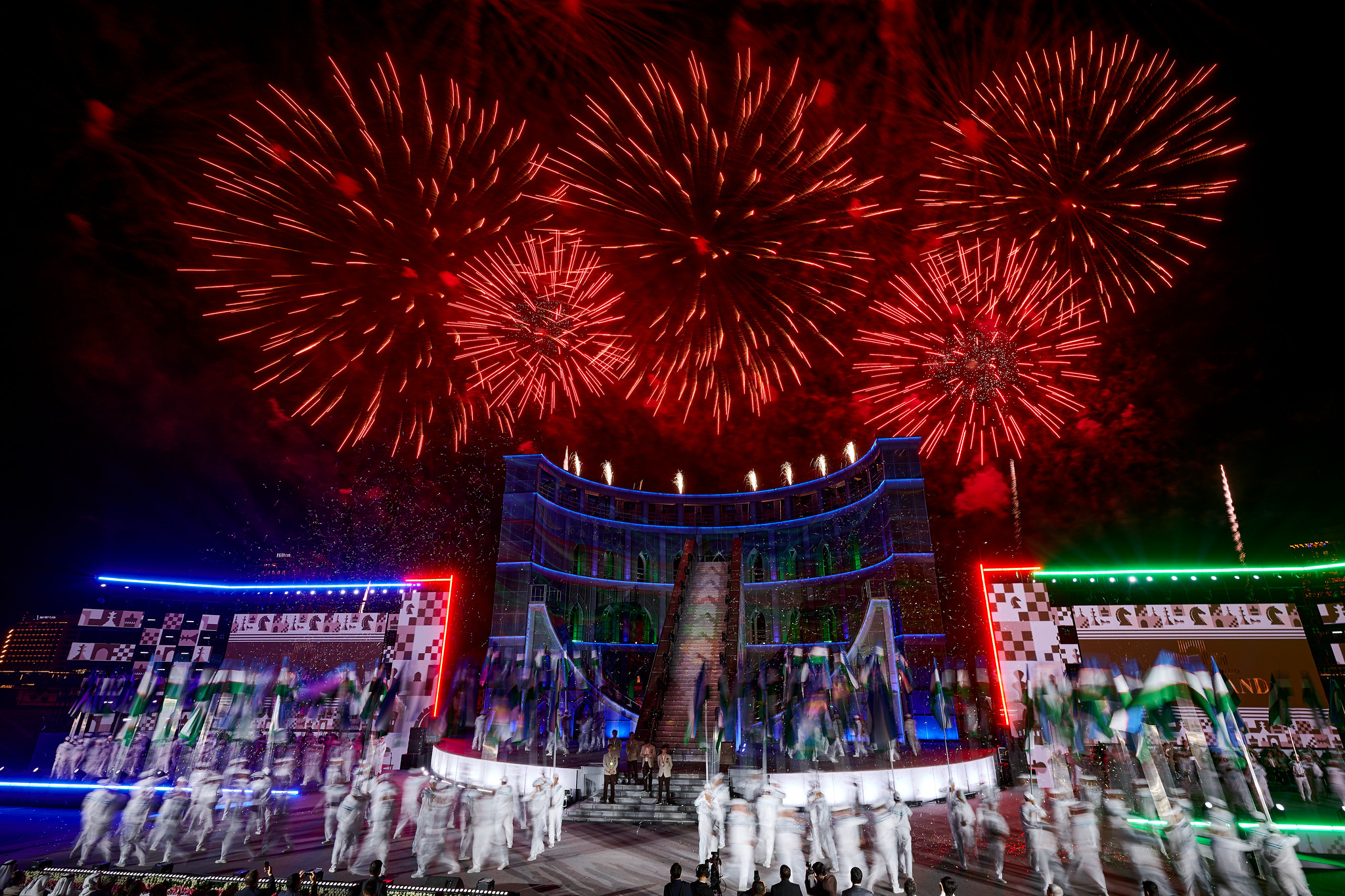
The closing ceremony, held at the Amphitheatre of the Eternal City, featured the presentation of medals and trophies before the Olympiad flag was handed over to representatives of the United Arab Emirates, hosts of the 2028 edition. The 47th Chess Olympiad will be held in Abu Dhabi in 2028.

The event brought together more than a thousand players and national delegations from across the world, providing a major platform for international competition and cultural exchange.
What Samarkand Means for African Chess
The results from Samarkand offer both encouragement and a challenge for African chess.
The four category medals demonstrate that African teams can compete successfully within their rating groups. Algeria, Angola, Egypt, Uganda and South Africa’s positions in the continental rankings also show that competitive strength is distributed across different regions of the continent.

The age analysis provides another reason for optimism. The presence of very young teams, particularly in the Women’s Section, suggests that several federations are giving emerging players opportunities to compete at the highest level of international team chess.
Yet the next step must be to convert these promising performances into sustained competitiveness.
African federations need more regular high-level tournaments, stronger national leagues, structured junior development programmes, improved coaching systems and greater opportunities for players to compete internationally. The continent also needs stronger institutional and financial support to ensure that promising players are not limited by access to resources.

The challenge is not simply to celebrate a category medal or a strong final position. It is to build the structures that make such performances repeatable — and eventually enable African teams to challenge for the overall Olympiad podium.
Samarkand showed that African chess is making progress. The task ahead is to turn that progress into lasting competitive strength.
Africa Chess Media
Promoting African chess content about Africans and for Africans.
Sources and results
- FIDE — Samarkand’s grand Olympiad finale and official awards
- African Chess Confederation — Africa’s category medal winners
- Chess-Results — Open Section
- Chess-Results — Women’s Section
- Chess-Results — Open player list and team records
- Chess-Results — Women’s player list and team records
Birth years for the age analysis were checked against FIDE player profiles. For the latest individual ratings across the continent, see our November 2026 African Ratings Roundup.
